Updated November 2026 · Research-based guide · We may earn a commission from links on this page.
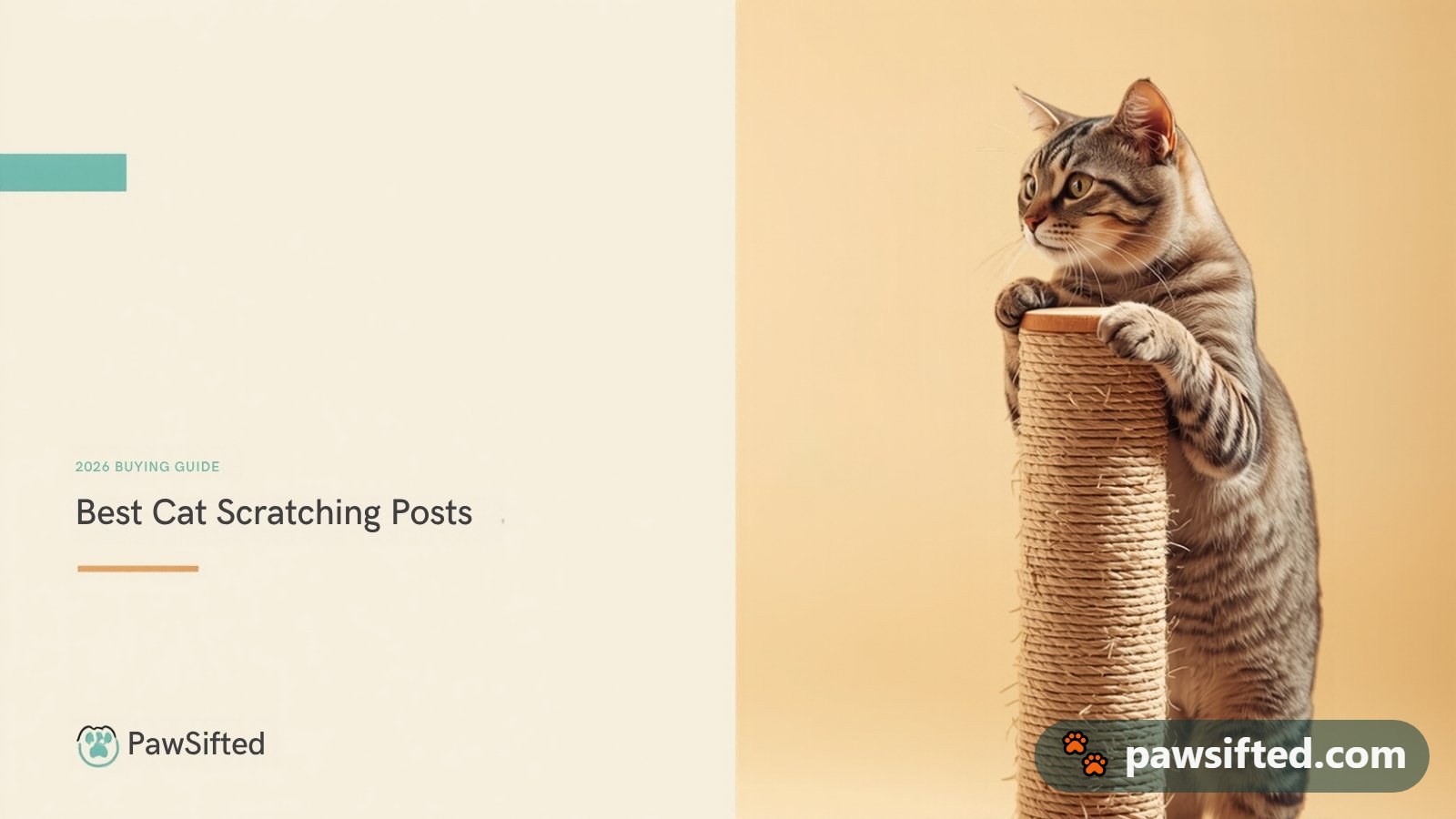
The best cat scratching posts give your cat something it actually prefers over the arm of your sofa. Scratching is not bad behavior: the ASPCA, Cornell’s Feline Health Center and International Cat Care all describe it as a normal way for cats to stretch, shed the worn outer layer of their claws and leave scent marks. The goal is to redirect it, not stop it.
That is why there is no single best post. A long-bodied cat that stretches up the couch needs a tall, heavy sisal post that won’t wobble. A cat that shreds the rug wants something flat. Kittens and older cats often prefer low or angled cardboard. Below are six picks that cover those styles, followed by tips on where to put them so they get used.
Top picks at a glance
Best for tall cats
Amazon Basics Sturdy Cat Scratching Post, Large (35.4″)
35.4 inches tall for cats that love a full stretch
Best with a built-in toy
PAWZ Road Large Cat Scratching Post 32″
32-inch sisal post with a 16-inch plush base and hanging toy
Best for wall-and-floor scratchers
FUKUMARU 26.8″ L-Shaped Cat Scratcher
one cardboard piece that works upright, flat or as a hideout
Best for kittens and multi-cat homes
Kitty City XL 3-Pack Cat Scratcher Pads
three double-sided cardboard pads for more scratching spots
Best overall
1. SmartCat Ultimate Scratching Post
Pioneer Pet’s SmartCat Ultimate is a 32-inch post wrapped in woven sisal fabric on a 16 x 16-inch base, and the maker lists the whole thing at roughly 17 pounds. That combination of height and weight matches what the ASPCA and Cornell’s Feline Health Center ask for: a post tall enough for a full stretch and sturdy enough that it doesn’t shift when the cat leans in. Popular Science and PetsRadar both named it their best overall scratching post. It assembles with two included screws, and Pioneer Pet sells replacement top, bottom and base pieces if one wears out.
- Good: tall, heavy and stable, with a tight woven sisal surface that claws grip without snagging the way looped carpet can.
- Watch out: the sisal covering isn’t sold on its own, so a shredded post means buying a replacement section; it costs more than basic posts.
- Skip it if: your cat only scratches rugs and floors and has never shown interest in vertical surfaces.
Best for tall cats
2. Amazon Basics Sturdy Cat Scratching Post, Large (35.4″)
If your cat is long and loves a full vertical stretch, height matters most. The Large version of this Amazon Basics post stands 35.4 inches tall on a 15.75-inch square wood base, and it comes with a replaceable dangle toy. Amazon describes the scratching surface as natural jute fiber (the title also mentions sisal rope), so expect a slightly softer, rougher wrap than the SmartCat’s woven sisal. PetsRadar chose the smaller 31.5-inch version as its budget pick but noted it may not suit heavier cats, so the taller Large is the one to look at for big cats.
- Good: the tallest post in this guide, a simple single-pillar design, and a toy that can be swapped out.
- Watch out: the base is a little smaller than the SmartCat’s even though the post is taller, so a heavy, energetic scratcher may make it rock.
- Skip it if: you have a very heavy cat that throws its full weight into scratching.
Best with a built-in toy
3. PAWZ Road Large Cat Scratching Post 32″
PAWZ Road’s large post is 32 inches tall with a 16 x 16-inch base covered in plush fabric, a natural sisal wrap and a hanging bird toy on top. It goes together with two included screws. The plush base gives cats a soft spot to stand on, and the dangling toy can help draw a curious cat to the post in the first place, which the ASPCA suggests as a way to build the habit. It’s a solid alternative to the SmartCat if you want the same height and base footprint in a darker color.
- Good: same height and base size as our top pick, plus a toy to attract interest.
- Watch out: PAWZ Road’s listings don’t all agree on the base material and size (another listing says 15 x 15 inches and particle board), so confirm the details on the product page before ordering.
Best for wall-and-floor scratchers
4. FUKUMARU 26.8″ L-Shaped Cat Scratcher
Some cats scratch walls and door frames, others the floor, and plenty do both. FUKUMARU’s L-shaped scratcher is made of 1.6-inch-thick corrugated cardboard and measures 26.8 x 16.6 x 11.5 inches. The maker says it can stand upright against a wall as a vertical scratcher, lie flat as a lounge, or be turned over as a small hideout, and it comes with a ball toy. That flexibility is handy while you’re still learning what your cat prefers, which is exactly the trial-and-error approach the ASPCA recommends.
- Good: three ways to use it, a good vertical scratching height for most cats, and cardboard that many cats find easy to dig into.
- Watch out: it leans against the wall rather than mounting to it, so a heavy cat can push it around; cardboard also sheds crumbs and wears faster than sisal.
Best lounger for nappers
5. Necoichi Cat Scratcher Bowl
International Cat Care points out that cats often scratch right after waking up, so a scratcher that doubles as a bed is a smart idea. Necoichi’s bowl is about 15.7 inches across, shaped with a cat-head silhouette, and made from 100% recycled paper. The scratching pad is reversible and replaceable, so you can flip it when one side gets worn and swap in a new pad later instead of throwing the whole thing out. It’s also attractive enough to leave in a living room.
- Good: bed and scratcher in one, a reversible pad that is easy to replace, and a tidy look.
- Watch out: it’s low and compact, so it won’t give a full upright stretch, and a large cat may hang over the edges.
- Skip it if: you need a main scratcher for a cat that stretches up furniture; pair it with a tall post instead.
Best for kittens and multi-cat homes
6. Kitty City XL 3-Pack Cat Scratcher Pads
Flat pads are the easiest way to give a horizontal scratcher, a kitten or an older cat more places to scratch. Each Kitty City XL pad measures 10 x 18 x 1.5 inches, is made from double-sided recycled corrugated cardboard, and the pack includes three, which also fit as refills in some Kitty City furniture. International Cat Care suggests one scratching post per cat plus one extra in multi-cat homes, and a three-pack makes it easy to put a pad by the bed, near the door and next to the sofa.
- Good: three pads in one pack, double-sided for longer use, and well suited to cats that like to scratch flat.
- Watch out: flat pads can slide on hard floors and wear out faster than sisal, and they don’t offer any vertical stretch.
Compare the picks side by side
| Pick | Best for | Why it stands out | Main trade-off |
|---|---|---|---|
| SmartCat Ultimate Scratching Post | Best overall | A 32-inch woven sisal post on a heavy 16-inch base | The sisal covering isn’t sold on its own, so a shredded post means buying a replacement section; it costs more than basic posts. |
| Amazon Basics Sturdy Cat Scratching Post, Large (35.4″) | Best for tall cats | 35.4 inches tall for cats that love a full stretch | The base is a little smaller than the SmartCat’s even though the post is taller, so a heavy, energetic scratcher may make it rock. |
| PAWZ Road Large Cat Scratching Post 32″ | Best with a built-in toy | 32-inch sisal post with a 16-inch plush base and hanging toy | PAWZ Road’s listings don’t all agree on the base material and size (another listing says 15 x 15 inches and particle board), so confirm the details on the product page before ordering. |
| FUKUMARU 26.8″ L-Shaped Cat Scratcher | Best for wall-and-floor scratchers | One cardboard piece that works upright, flat or as a hideout | It leans against the wall rather than mounting to it, so a heavy cat can push it around; cardboard also sheds crumbs and wears faster than sisal. |
| Necoichi Cat Scratcher Bowl | Best lounger for nappers | A curved cardboard bed that is also a scratcher | It’s low and compact, so it won’t give a full upright stretch, and a large cat may hang over the edges. |
| Kitty City XL 3-Pack Cat Scratcher Pads | Best for kittens and multi-cat homes | Three double-sided cardboard pads for more scratching spots | Flat pads can slide on hard floors and wear out faster than sisal, and they don’t offer any vertical stretch. |
Which cat scratching post fits your routine?
Your cat attacks the sofa arm
Go tall and vertical: the SmartCat Ultimate or PAWZ Road post. Cornell’s Feline Health Center suggests matching the surface the cat already uses, and sisal is the usual stand-in for upholstery. Place it right next to the sofa at first.
You have a big, long-bodied cat
Height and base weight matter most. The 35.4-inch Amazon Basics Large gives the most reach; the SmartCat gives the heaviest, most stable base.
Your cat shreds the rug
Rug scratchers are usually horizontal scratchers. Start with Kitty City pads or the FUKUMARU laid flat, placed on or near the rug they’re targeting.
You have a kitten
Kittens start scratching at around five weeks, according to International Cat Care. Low cardboard pads work well now; add a tall post as they grow so they can stretch fully.
You have a senior cat
Older cats often shift toward horizontal or angled scratching, which the FelineVMA notes too. The Necoichi bowl or flat pads are easier on stiff joints than a tall post.
You have several cats
Plan on one scratcher per cat plus one, in different rooms. Mix one tall sisal post with a few cardboard pads so every cat has a style it likes.
How to choose a cat scratching post
Height: enough for a full stretch
Cornell’s Feline Health Center says a post should be at least as tall as your cat standing on its hind legs with front legs stretched out. If you’re unsure, measure your cat at full stretch before you buy. Look at the length of the scratchable surface, not just the overall height.
Stability: it must not wobble
Every source we checked agrees on this. International Cat Care notes that lightweight posts that move may simply be ignored, because the cat gets no resistance. A wide, heavy base matters more than extras like toys or perches.
Surface: sisal, cardboard or something else
The ASPCA suggests offering a few materials, such as sisal, cardboard, carpet and wood, and then buying more of whatever your cat chooses. Woven or rope sisal is durable and suits cats that scratch furniture; corrugated cardboard suits horizontal scratchers but wears faster.
Orientation: vertical, horizontal or angled
Most cats prefer vertical surfaces, but some like scratching flat or on a slope, and preferences can change with age. If you don’t know yet, a flexible piece like the FUKUMARU lets you test both.
Placement: where your cat already scratches
Put the post next to the furniture your cat targets, near its favorite sleeping spot, or by a door or window, which the FelineVMA describes as common scratching spots. You can move it gradually once the habit is set.
Replaceable parts
Posts take a beating. A replaceable pad or post section, like on the Necoichi bowl or SmartCat, extends the life of the scratcher. Don’t rush to throw out a worn post, though: the ASPCA notes that cats often like a well-shredded surface.
Frequently asked questions
How tall should a cat scratching post be?
Tall enough for your cat to stretch out fully on its hind legs, which is the guidance from Cornell’s Feline Health Center and International Cat Care. Many popular posts, including our top pick, are about 32 inches tall; for a very long cat, measure its full stretch and consider a taller post like the 35.4-inch Amazon Basics Large.
Is sisal or cardboard better?
Neither is better for every cat. Sisal lasts longer and suits cats that scratch furniture vertically. Cardboard is popular with horizontal scratchers, kittens and seniors but wears out faster. Many households end up with both.
How do I get my cat to use the scratching post?
Place it where your cat already scratches or near where it sleeps, rub catnip on it or dangle a wand toy against it, and reward your cat with treats or praise when it scratches there. Never force your cat’s paws onto the post, which International Cat Care and the ASPCA both advise against.
How many scratching posts do I need?
International Cat Care recommends one per cat plus one extra in multi-cat homes, spread out in different locations. Even a single cat benefits from more than one, such as a tall post in the living room and a pad by the bed.
Should I declaw my cat to stop scratching?
No. The ASPCA and the Feline Veterinary Medical Association oppose declawing, and Cornell’s Feline Health Center explains that it amputates bone and does not remove the urge to scratch. Scratchers, regular nail trims and nail caps are the humane alternatives. For behavior concerns, talk to your veterinarian.
How we chose
We did not test these scratching posts hands-on. We started from scratching guidance published by the ASPCA, Cornell’s Feline Health Center, International Cat Care and the Feline Veterinary Medical Association, then compared products against those criteria (height, stability, surface and orientation) using manufacturer and Amazon product details, picks from outlets such as Popular Science and PetsRadar, and recurring themes in customer reviews. We confirmed each product was listed on Amazon US and found no CPSC recalls for cat scratching posts at the time of writing. We do not accept payment for placement. Read our full editorial policy.
Sources and further reading
- Destructive Scratching (ASPCA): explains why cats scratch and how to redirect it with sturdy, tall posts in materials the cat prefers.
- Feline Behavior Problems: Destructive Behavior (Cornell Feline Health Center): covers matching the post surface to the cat’s habits, post height and placement, and why declawing is not a fix.
- Scratching on furniture and carpets (International Cat Care): describes post height, stability, surface options and how many scratchers multi-cat homes need.
- Training Techniques for Addressing Undesirable Behaviors (Feline Veterinary Medical Association): outlines vertical versus horizontal preferences, placement near resting spots and reward-based training.