Updated November 2026 · Research-based guide · We may earn a commission from links on this page.
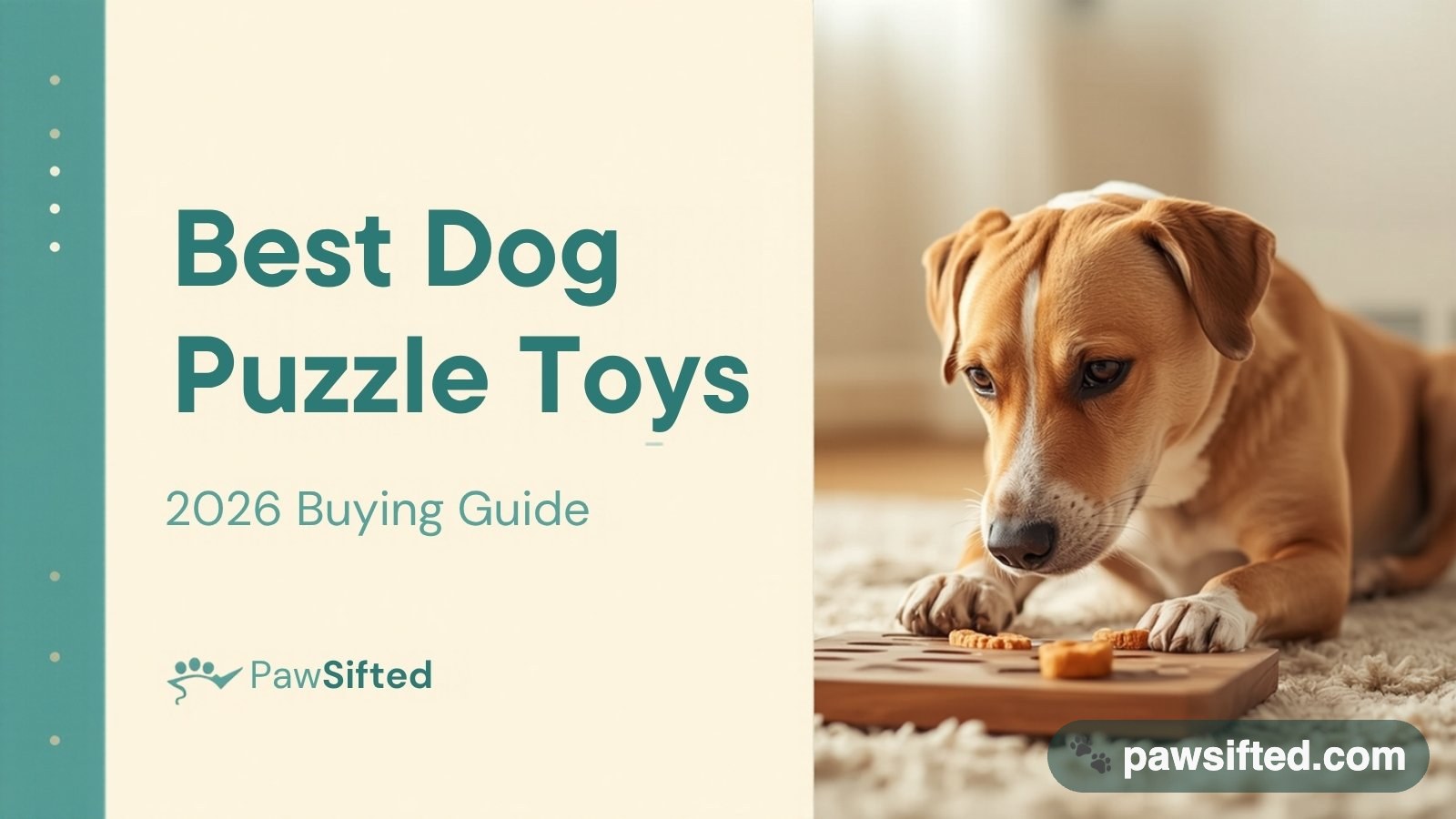
A bored dog will find its own projects, usually your shoes, the couch cushions or the trash. The best dog puzzle toys give that energy a job: your dog sniffs, paws, slides and lifts pieces to earn food, which works the brain as well as the nose. A short puzzle session will not replace a walk, but it can take the edge off a rainy day or a long workday.
There is no single best puzzle for every dog. A first-timer needs quick wins, a seasoned solver needs multi-step challenges, and a hard chewer needs something without small removable parts. Below we group our picks by difficulty level (most brands use a 1 to 4 scale) and by use case, based on manufacturer specs, retailer listings and expert roundups rather than hype.
Top picks at a glance
Best overall
Outward Hound Nina Ottosson Dog Tornado
Spinning tiers and optional covers make it a puzzle your dog can grow into.
Best for beginners
Outward Hound Nina Ottosson Dog Smart
A one-step, lift-the-cover game that teaches the puzzle concept.
Best for advanced puzzlers
Outward Hound Nina Ottosson Challenge Slider
24 sliding compartments for dogs that have outgrown Level 2.
Best for sniffing and slow eating
PAW5 Wooly Snuffle Mat
A nose-work game with no hard parts, good for puppies and seniors.
Best for tougher play
West Paw Toppl Treat Toy
A stuffable, dishwasher-safe toy without small loose pieces.
Best overall
1. Outward Hound Nina Ottosson Dog Tornado
The Dog Tornado is a Level 2 (intermediate) puzzle built around three stacked tiers that spin to uncover treats. Retail listings describe 12 hidden compartments plus three bone-shaped covers you can add once your dog figures out the spinning motion, so one toy can grow with your dog. It measures roughly 9.75 x 7.25 x 3 inches and is listed as made from BPA-, PVC- and phthalate-free plastic. Most dogs solve it by pawing or nosing the layers, so it suits curious dogs that have already tried a simple puzzle.
- Good: Adjustable difficulty with optional covers; works with kibble or small treats; compact footprint.
- Watch out: Hand wash only, and the small compartments need to dry fully before reuse. Dogster notes it is best suited to smaller dogs.
- Skip it if: your dog is brand new to puzzles and gives up easily. Start with a Level 1 game instead.
Best for beginners
2. Outward Hound Nina Ottosson Dog Smart
If your dog has never done a puzzle, the Dog Smart is the classic starting point. It is a Level 1 board with nine treat wells, each hidden under a bone-shaped cover. Your dog only needs to learn one action, lifting or nudging a cover, and you can set the covers flush or slightly raised to change how hard that is. It is a simple way to teach the core idea that moving things earns food before you invest in a harder game.
- Good: Simple one-step concept builds confidence; nine wells hold a decent snack portion; easy to make slightly harder.
- Watch out: The removable covers are small enough to chew, and customer reviews on retailer sites warn against leaving dogs alone with it. Hand wash with soap and water.
- Skip it if: your dog solves things in seconds or treats every plastic piece as a chew.
Best value
3. Trixie Activity Flip Board
Trixie’s Activity Flip Board packs two kinds of challenges into one flat board: lift-out cones and flip-open lids that hide treats. It is rated Level 2. The cones are designed so they cannot simply be knocked over; your dog has to lift them straight up, which slows down dogs that bulldoze through easier games. PetSmart lists it at about 9 x 9 x 1 inches in plastic and rubber, with a non-slip rubber rim, and describes it as dishwasher safe.
- Good: Two skills in one toy; dishwasher safe; low, flat board is hard to tip.
- Watch out: The lift-out cones are removable parts, so supervise play. Experienced dogs may finish it quickly.
Best for advanced puzzlers
4. Outward Hound Nina Ottosson Challenge Slider
Once your dog breezes through Level 2 games, the Challenge Slider raises the bar. This Level 3 puzzle has 24 compartments in a pull-out tray that holds up to about one cup of food, and your dog has to slide pieces in different directions to reach them. Outward Hound says it is meant for dogs that have mastered levels 1 and 2 and suggests showing your dog how the pieces move at first. Because it holds a meal-sized portion of kibble, some owners use it at dinnertime.
- Good: Lots of compartments for longer sessions; food-safe materials listed as BPA-, PVC- and phthalate-free; can stand in for a bowl.
- Watch out: The manufacturer stresses close supervision and says not to let dogs chew the game. Hand wash with mild soap and warm water.
- Skip it if: your dog is a first-timer or tends to flip toys when frustrated. Work up to it.
Best multi-step challenge
5. Trixie Mini Mover
Trixie’s Mini Mover is a Level 3 strategy game that combines sliders, cones, knobs and drawers, so a single treat can take several steps to reach. You can rearrange the cones to change the challenge, and it comes with a booklet of training tips. PetSmart lists it at 9.75 x 7.75 x 3 inches with non-slip rubber feet. Hepper named it its top overall pick, while noting that bigger dogs may pick it up and shake it instead of solving it.
- Good: Several mechanisms in one toy; non-slip feet; rearrangeable for variety.
- Watch out: The smaller footprint suits small and medium dogs better than large breeds, and the rope and small parts call for supervision.
- Skip it if: your dog is large and impatient. It may get carried off rather than solved.
Best for sniffing and slow eating
6. PAW5 Wooly Snuffle Mat
Not every brain game needs moving parts. A snuffle mat hides kibble or treats among fabric strands, so your dog has to use its nose to forage. The PAW5 Wooly Snuffle Mat is one of the best-known versions, and Chewy lists it as machine washable on warm with a low tumble dry. It is a low-frustration option for puppies, seniors and dogs that find hard plastic puzzles stressful, and it naturally slows down gulpers.
- Good: Easy for any age; no hard pieces; machine washable.
- Watch out: Hepper notes it holds water and gets heavy when washed. Enthusiastic dogs may shred fabric, so supervise.
- Skip it if: your dog tends to chew and swallow fabric.
Best for tougher play
7. West Paw Toppl Treat Toy
The West Paw Toppl is a treat-dispensing toy rather than a board puzzle, and that is why it earns a spot here. You stuff it with kibble, soft food or treats, and your dog rolls, nudges and licks to get them out. It is made from West Paw’s Zogoflex Echo material, is dishwasher safe and floats, and comes in small, large and X-large sizes. Two neighboring sizes can be interlocked for a harder challenge. PetSmart describes it as built for moderate chewers.
- Good: No small removable parts; dishwasher safe; you control difficulty by how tightly you pack it.
- Watch out: Not marketed for extreme chewers. Choose a size your dog cannot fit fully in its mouth.
- Skip it if: your dog destroys rubber toys in minutes.
Compare the picks side by side
| Pick | Best for | Why it stands out | Main trade-off |
|---|---|---|---|
| Outward Hound Nina Ottosson Dog Tornado | Best overall | Spinning tiers and optional covers make it a puzzle your dog can grow into. | Hand wash only, and the small compartments need to dry fully before reuse. Dogster notes it is best suited to smaller dogs. |
| Outward Hound Nina Ottosson Dog Smart | Best for beginners | A one-step, lift-the-cover game that teaches the puzzle concept. | The removable covers are small enough to chew, and customer reviews on retailer sites warn against leaving dogs alone with it. Hand wash with soap and water. |
| Trixie Activity Flip Board | Best value | Cones plus flip lids for two skills, and it is dishwasher safe. | The lift-out cones are removable parts, so supervise play. Experienced dogs may finish it quickly. |
| Outward Hound Nina Ottosson Challenge Slider | Best for advanced puzzlers | 24 sliding compartments for dogs that have outgrown Level 2. | The manufacturer stresses close supervision and says not to let dogs chew the game. Hand wash with mild soap and warm water. |
| Trixie Mini Mover | Best multi-step challenge | Sliders, knobs, drawers and cones combined on one board. | The smaller footprint suits small and medium dogs better than large breeds, and the rope and small parts call for supervision. |
| PAW5 Wooly Snuffle Mat | Best for sniffing and slow eating | A nose-work game with no hard parts, good for puppies and seniors. | Hepper notes it holds water and gets heavy when washed. Enthusiastic dogs may shred fabric, so supervise. |
| West Paw Toppl Treat Toy | Best for tougher play | A stuffable, dishwasher-safe toy without small loose pieces. | Not marketed for extreme chewers. Choose a size your dog cannot fit fully in its mouth. |
Which dog puzzle toy fits your routine?
First-time puzzle dog
Start with a Level 1 board like the Dog Smart or a snuffle mat. Let your dog watch you load it, use smelly treats, and keep sessions short so every game ends in success.
Fast eaters
A snuffle mat or a high-compartment puzzle like the Challenge Slider spreads a meal out. For everyday meals, a slow feeder dog bowl is a simpler daily option. If your dog gulps food for a medical reason, check with your vet before changing how you feed.
Puzzle pros
Dogs that clear a Level 2 game in a minute need multi-step puzzles such as the Mini Mover or Challenge Slider. Rotate two or three puzzles so none becomes routine.
Heavy chewers
Skip boards with small lift-out pieces. A sturdy stuffable toy like the Toppl, used under supervision, is a safer way to add a food challenge.
Puppies
Choose easy fabric or rubber options and keep sessions short. Puppies tire quickly and learn best when the reward comes fast.
Seniors and less mobile dogs
Low, flat puzzles and snuffle mats let older dogs work their nose and brain without much physical effort.
How to choose the best dog puzzle toys
Difficulty level
Most brands rate puzzles from 1 to 4. Level 1 is usually a single action, such as lifting a cover. Level 2 adds a second kind of move, and Level 3 and up require sequences such as sliding a piece and then lifting another. Hepper suggests stepping down a level if your dog gets frustrated rather than pushing through.
Removable parts and safety
Bones, cones and covers are what make many puzzles work, but they are also the pieces a determined dog can chew or swallow. Treat puzzle toys as supervised toys: put them away after the game and check them for cracks and bite marks. Humane World for Animals (formerly the Humane Society of the United States) advises supervising play with toys that can be torn apart and throwing out toys that break or tear.
Size and stability
Compare the dimensions to your dog. Large dogs can flip or carry off small boards, while tiny dogs may struggle with tall tiers. Non-slip feet or rubber rims help keep a board in place on hard floors.
Materials
Look for brands that state food-safe, BPA-free plastics or rubber compounds. Wooden puzzles look attractive, but Hepper points out that particleboard versions can swell or chip if they get wet.
Cleaning
Food residue collects in corners and crevices. Dishwasher-safe options save time, but several popular Nina Ottosson puzzles are listed as hand wash only, so check the care label and let compartments dry fully before the next round.
Frequently asked questions
Are puzzle toys good for dogs?
For most dogs, yes. Food puzzles add mental exercise and slow down eating, and they are a common enrichment tool. They should add to walks and play, not replace them.
How long should my dog play with a puzzle toy?
A few minutes up to about 15 minutes is usually plenty, especially at first. End while your dog is still succeeding, then put the toy away until next time.
Can I feed a whole meal in a puzzle toy?
Some puzzles, like the Challenge Slider, hold around a cup of kibble, so they can work at mealtime. Count puzzle treats toward daily calories and ask your vet if your dog is on a special diet.
What if my dog gets frustrated?
Drop down a difficulty level, show your dog how the piece moves, or switch to higher-value treats. Flipping or chewing the toy is often a sign the game is too hard right now.
Can I leave my dog alone with a puzzle toy?
Most board puzzles should not be left with an unsupervised dog, and Outward Hound tells owners to supervise closely. Ask your vet or trainer which durable toy suits alone time for your dog. This guide is not veterinary advice.
How we chose
We compared current expert roundups from Dogster and Hepper with manufacturer and retailer product pages from Outward Hound, Trixie, West Paw, PetSmart and Chewy, focusing on difficulty level, removable parts, materials, cleaning and size. We also searched for recalls on these puzzle toys and did not find any. We did not test these products hands-on; specs come from the listed manufacturers and retailers, and models change, so check the current listing before you buy. Read our full editorial policy.
Sources and further reading
- Brain Games for Dogs: When Can a Puzzle Be the Solution? (American Kennel Club): Describes the main types of food puzzle toys, when they help (alone time, crate rest, training), and why durability and size should match the dog.
- Nina Ottosson Dog Tornado (Outward Hound): Manufacturer page listing the Level 2 rating, three tiers, 12 compartments, three bone-shaped covers, hand-wash care, and a warning to supervise and not let dogs chew the pieces.
- How to pick the best and safest dog toys (Humane World for Animals): Advises supervising play with toys that can be torn apart, discarding toys that break or tear, and using feeder-style toys for dogs that eat too fast.