
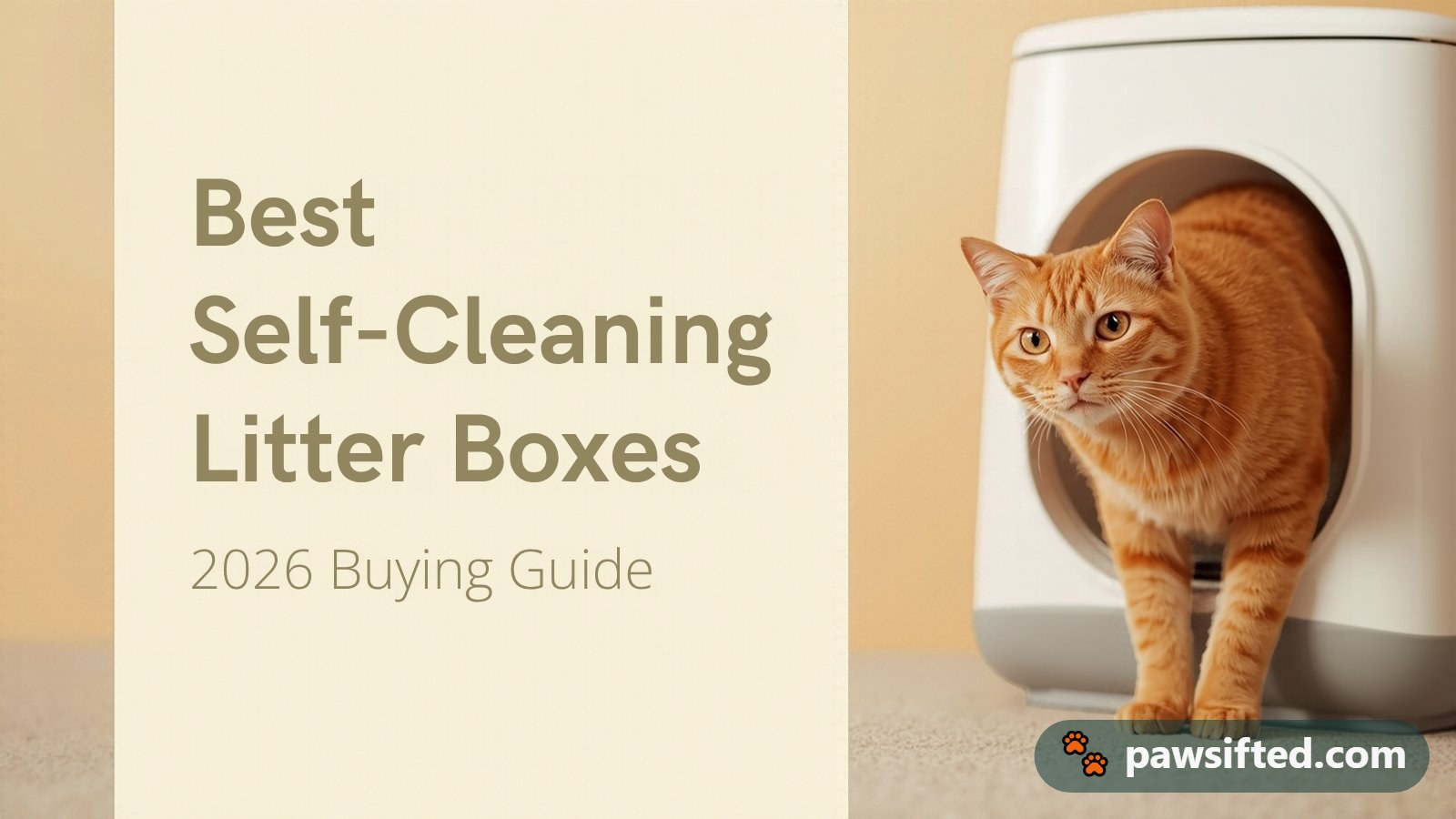
Updated November 2026 · Research-based guide · We may earn a commission from links on this page.
Scooping every day is one of the least-loved parts of living with a cat, and the best self-cleaning litter boxes promise to take most of that chore off your list. After your cat leaves, they sift or rake waste into a sealed drawer or tray, so the box stays cleaner between your visits and odor has less time to build up.
Still, the best self-cleaning litter box for you depends on your cat and your home. A machine that suits two 10-pound cats may be the wrong fit for a 20-pound Maine Coon, a nervous kitten, or a household that won’t give up clumping clay. Below we compare six well-reviewed options by cleaning method, weight range, litter rules and upkeep, so you can match the box to your routine.
Top picks at a glance
Best for multi-cat homes
Litter-Robot 4 by Whisker
Proven sifting globe for up to four cats from 3 to 25 lb.
Best app-connected alternative
PetSafe ScoopFree SmartSpin
Sifting drum, 6-liter drawer and weight tracking for cats up to 25 lb.
Best for large cats
Neakasa M1 Open-Top
Open-top design, 2.2 to about 33 lb range and a 14-day waste bin.
Best for health monitoring
PETKIT Purobot Max Pro 2
AI camera, per-cat tracking and drawstring-bag disposal.
Best low-maintenance tray system
PetSafe ScoopFree Crystal Pro (Hooded)
Rake plus disposable crystal trays that last up to a month.
Best for multi-cat homes
1. Litter-Robot 4 by Whisker
The Litter-Robot 4 is the model most roundups use as the benchmark. Instead of a rake, its globe rotates to sift clumps through a screen and drop them into a drawer below, starting a few minutes after your cat leaves (you can stretch the delay to as long as 30 minutes). Whisker rates it for up to four cats weighing 3 to 25 pounds. Laser and weight sensors detect when a cat is inside, a drawer-full indicator warns you before it overflows, and the Whisker app logs visits and tracks your cat’s weight. Depending on how many cats use it, Whisker says the drawer may only need emptying about once every 8 days.
- Good: Wide weight range, room for up to four cats, entry-and-exit detection with laser and weight sensors, app alerts and usage history, and it works with ordinary clumping clay.
- Watch out: It is a big unit (about 22 x 27 inches of floor space and 29.5 inches tall), the app needs 2.4 GHz Wi-Fi, and plant-based, wood pellet and non-clumping litters won’t work. Very white or translucent litter can confuse the drawer sensor.
- Skip it if: you have a small bathroom or closet with no room for a tall globe, or you are committed to pine or paper litter.
Best app-connected alternative
2. PetSafe ScoopFree SmartSpin
PetSafe’s SmartSpin is a sifting box from the brand best known for crystal trays, and it suits owners who want automation without changing litter. PetSafe says it works with most litters but performs best with a premium clumping formula. The drum sifts clumps into a sealed, deodorized 6-liter drawer that the company says holds up to two weeks of waste. It senses when your cat has left before it cycles, has a child lock, and connects to the PetSafe app over 2.4 GHz Wi-Fi to track weight changes and bathroom visits. PetSafe rates it for cats up to 25 pounds and multi-cat homes.
- Good: Large 6-liter drawer, cat-weight and usage tracking in the app, child lock, and flexibility on clumping litter brands.
- Watch out: Ongoing costs include drawer liners and deodorizer packs, PetSafe doesn’t publish a minimum cat weight on the product page, and the Wi-Fi is 2.4 GHz only.
- Skip it if: you have a young kitten and can’t confirm the minimum weight with PetSafe first.
Best for large cats
3. Neakasa M1 Open-Top
Some cats simply refuse hooded boxes, and that’s where the Neakasa M1 stands out. Its open-top body rotates to sift waste into a bin with a Pull & Wrap bag system. Neakasa lists a wide weight range of 2.2 to about 33 pounds, plus a Kitten Mode that turns auto-cleaning off for smaller cats. The waste bin holds 11.23 liters, which the company says covers up to 14 days, and the entry sits about 13.9 inches high. Neakasa also lists infrared and weight sensors, a pinch-free rotation design and operating noise at or below 50 dB, with an app for usage logs and remote control. Technomeow’s roundup also singles out the M1 line for large-cat and multi-cat homes.
- Good: Open, airy design for cats that dislike hoods, the highest listed weight limit in this guide, a big waste bin, and Kitten Mode.
- Watch out: It needs fast-clumping litter; highly absorbent, loosely clumping, paper and wood pellet litters aren’t compatible. Neakasa sells several M1 versions (such as M1 Lite and M1 Plus) with different bundles, so check which one you’re buying. An open top can also let more litter scatter than a covered unit.
- Skip it if: your cat is an enthusiastic digger who kicks litter over the sides.
Best for health monitoring
4. PETKIT Purobot Max Pro 2
If you want the most data about your cat’s bathroom habits, the PETKIT Purobot Max Pro 2 is the most feature-packed pick here. It pairs weight sensors with an AI camera that PETKIT says can recognize up to 15 cats, and the app offers stool monitoring, inactivity alerts and, with PETKIT’s own urine-monitor litter, urine pH checks. Cleaning happens in a rotating cylinder that packs waste into a drawstring bag inside an 8-liter bin. PETKIT lists 12 safety sensors, an anti-pinch design, a dual deodorizing system and Wi-Fi on both 2.4 and 5 GHz. The stated weight range is 3.3 to 22 pounds.
- Good: Per-cat recognition for busy households, camera-based health features, sealed drawstring bags, and dual-band Wi-Fi.
- Watch out: Litter granules must stay within PETKIT’s size limits (about 12 mm long and 3 mm wide or smaller), and the brand recommends its own bags, filters and sifters. Some features, such as longer video history, need a paid plan, and a camera aimed at the litter area won’t suit every household. The 22-pound ceiling is lower than the Litter-Robot 4 or Neakasa M1.
- Skip it if: your cat is over 22 pounds or you’d rather have a simple box without a camera.
Best low-maintenance tray system
5. PetSafe ScoopFree Crystal Pro (Hooded)
The ScoopFree line takes a different approach. A rake pushes solid waste into a covered section of a disposable tray filled with crystal litter, which absorbs urine and helps it dry out. PetSafe says one tray can last up to 30 days, and when it’s done you lift out the tray and toss it. The Crystal Pro adds a hood, a health counter that tallies visits, and an indicator light that tells you when to change the tray. Catster also notes that the low, wide ScoopFree shape is easy for kittens and senior cats to step into.
- Good: Almost no handling of waste, simple setup with no app or Wi-Fi to manage, and a health counter for tracking visits.
- Watch out: It only works with official ScoopFree crystal trays (disposable or reusable), so you’re locked into that litter, and some cats dislike the feel of crystals. It’s long, at roughly 28 x 20 inches.
- Skip it if: your cat will only use clumping clay.
Best no-power budget pick
6. Omega Paw Roll ‘n Clean
Not every self-cleaning litter box needs a motor. The Omega Paw Roll ‘n Clean is a manual box with a built-in grid: you roll the box over and back, and clumps are separated into a tray you pull out and empty. There’s nothing to plug in and no sensors to fail, which makes it a sensible choice for a room without an outlet, a cat that’s frightened by motor noise, or anyone who wants to try a less-scooping routine before spending on an automatic unit. Catster names it the best-value pick in its roundup, and customer reviews credit it with trapping odor and limiting dust.
- Good: No electricity, no app or Wi-Fi, quiet, and strong value for a semi-automatic design.
- Watch out: You still do the rolling, so it’s semi-automatic rather than hands-free. Catster notes the plastic is less sturdy than premium units and the box can feel small for big cats or multi-cat homes.
- Skip it if: you need fully automatic cleaning while you travel.
Compare the picks side by side
| Pick | Best for | Why it stands out | Main trade-off |
|---|---|---|---|
| Litter-Robot 4 by Whisker | Best for multi-cat homes | Proven sifting globe for up to four cats from 3 to 25 lb. | It is a big unit (about 22 x 27 inches of floor space and 29.5 inches tall), the app needs 2.4 GHz Wi-Fi, and plant-based, wood pellet and non-clumping litters won’t work. Very white or translucent litter can confuse the drawer sensor. |
| PetSafe ScoopFree SmartSpin | Best app-connected alternative | Sifting drum, 6-liter drawer and weight tracking for cats up to 25 lb. | Ongoing costs include drawer liners and deodorizer packs, PetSafe doesn’t publish a minimum cat weight on the product page, and the Wi-Fi is 2.4 GHz only. |
| Neakasa M1 Open-Top | Best for large cats | Open-top design, 2.2 to about 33 lb range and a 14-day waste bin. | It needs fast-clumping litter; highly absorbent, loosely clumping, paper and wood pellet litters aren’t compatible. Neakasa sells several M1 versions (such as M1 Lite and M1 Plus) with different bundles, so check which one you’re buying. An open top can also let more litter scatter than a covered unit. |
| PETKIT Purobot Max Pro 2 | Best for health monitoring | AI camera, per-cat tracking and drawstring-bag disposal. | Litter granules must stay within PETKIT’s size limits (about 12 mm long and 3 mm wide or smaller), and the brand recommends its own bags, filters and sifters. Some features, such as longer video history, need a paid plan, and a camera aimed at the litter area won’t suit every household. The 22-pound ceiling is lower than the Litter-Robot 4 or Neakasa M1. |
| PetSafe ScoopFree Crystal Pro (Hooded) | Best low-maintenance tray system | Rake plus disposable crystal trays that last up to a month. | It only works with official ScoopFree crystal trays (disposable or reusable), so you’re locked into that litter, and some cats dislike the feel of crystals. It’s long, at roughly 28 x 20 inches. |
| Omega Paw Roll ‘n Clean | Best no-power budget pick | Roll-to-sift manual box that needs no outlet. | You still do the rolling, so it’s semi-automatic rather than hands-free. Catster notes the plastic is less sturdy than premium units and the box can feel small for big cats or multi-cat homes. |
Which self-cleaning litter box fits your routine?
Two to four cats
Look for a large waste drawer and a box rated for several cats. The Litter-Robot 4 (up to four cats), the SmartSpin with its 6-liter drawer, and the Neakasa M1 with its 14-day bin are the strongest fits. The usual guideline is one box per cat plus one (see how many litter boxes you need), so an automatic unit can replace some scooping without replacing every box.
A large or heavy cat
Check the maximum weight and the entry size before anything else. The Neakasa M1 lists the highest limit here (about 33 pounds), followed by the Litter-Robot 4 and SmartSpin at 25 pounds.
A kitten in the house
Most automatic boxes have a minimum weight: 3 pounds for the Litter-Robot 4 in automatic mode and 3.3 pounds for the PETKIT. Use the box with auto-cleaning off (or Kitten Mode on the Neakasa) until your kitten is above the limit, or choose the low-entry ScoopFree or the manual Omega Paw.
You hate handling litter
The ScoopFree Crystal Pro is the closest thing to lift-and-toss: when the tray is full, the whole thing goes in the trash. Drawer-based boxes with bag systems, like the PETKIT and Neakasa, are the next easiest.
You want health data
The PETKIT Purobot Max Pro 2 has the deepest tracking, with per-cat recognition and stool monitoring. The Litter-Robot 4 and SmartSpin both track weight and visits in their apps. Treat this data as an early-warning signal, not a diagnosis.
Small apartment or no outlet
Measure your space, including height for globe-style units. If there’s no outlet nearby or you want something compact and quiet, the manual Omega Paw Roll ‘n Clean avoids cords entirely.
How to choose a self-cleaning litter box
Cleaning method
There are three main designs. Rake systems drag waste into a covered compartment and often pair with crystal litter. Rotating globes, drums and cylinders sift clumps through a screen into a drawer below and usually need clumping litter. Manual roll-to-sift boxes have no motor and separate clumps when you roll them. Rotating designs tend to handle multiple cats well, while rake-and-tray systems are the simplest to empty.
Weight limits and kitten safety
Every automatic box should list a minimum and maximum cat weight, because its sensors rely on detecting a cat inside. Buy from brands that publish these limits and use weight or infrared sensors to pause cycles. Keep auto-cleaning off for kittens below the minimum, and watch the first few cycles yourself.
Litter compatibility
This is the most common source of regret. Most sifting boxes need fast, hard-clumping litter and reject pine, paper and wood pellets. Some limit granule size, and crystal-tray systems only take their own trays. If your cat is picky about texture, choose a box that works with the litter it already uses.
Waste capacity and consumables
Manufacturers quote capacity in days for one cat, so expect to empty more often with several cats. Budget for the ongoing extras: drawer liners or bags, carbon filters, deodorizer packs, or replacement crystal trays.
Size, entry height and noise
Globe-style units can be close to 30 inches tall, so measure your space. A lower entry helps kittens, seniors and cats with stiff joints. Check the brand’s stated noise level if the box will sit near a bedroom, and give nervous cats time to get used to the sound.
App, Wi-Fi and sensors
Apps add alerts, visit logs and weight tracking. Many work only on 2.4 GHz Wi-Fi, so check your router. More sensors generally means more reliable detection, but a simple box without an app can be easier to live with if you don’t want another device to manage.
How many litter boxes do you need?
The usual rule from the Cornell Feline Health Center, the ASPCA and Ohio State’s Indoor Pet Initiative is one litter box per cat, plus one. The ASPCA’s example: a home with three cats needs four boxes.
| Cats | Litter boxes |
|---|---|
| 1 | 2 |
| 2 | 3 |
| 3 | 4 |
| 4 | 5 |
Where to put them
Spread the boxes across different areas of the house instead of lining them up in one room, and keep them away from food and water (Cornell, Humane World for Animals). In a home with more than one floor, put a box on each level (Ohio State, ASPCA).
Box size and cleaning
A University of Illinois veterinary handout suggests a box about 1.5 times your cat’s length from nose to base of tail, and notes that many commercial boxes are too small. Scoop at least once a day and wash the box regularly; the ASPCA and Ohio State suggest weekly.
Does a self-cleaning box count?
It counts as one of the boxes. In our view, though, it shouldn’t be the only box in a multi-cat home: the plus-one rule is about giving every cat a choice, and an automatic unit can be mid-cycle, full or out of service. Some cats also find self-cleaning boxes intimidating (Humane World for Animals), and the ASPCA advises switching back to a regular box if your cat avoids one.
Frequently asked questions
Are self-cleaning litter boxes safe for cats?
Well-made models use weight, infrared or laser sensors to wait until your cat has left and to pause if a cat steps back in. Stick to established brands that publish weight limits and safety features, keep auto-cleaning off for kittens below the minimum weight, and supervise the first few days. If you have safety questions about your specific cat, ask your vet.
How do I get my cat to use a new self-cleaning box?
Go slowly. Catster suggests adding a little used litter from the old box and leaving the automatic cycle switched off until your cat is comfortable, then turning it on. Keeping the old box nearby for the first week or two gives your cat a fallback while it adjusts.
Do self-cleaning litter boxes still need cleaning?
Yes. You’ll still empty the waste drawer or tray, replace liners and filters, top up litter, and wash the unit periodically following the manufacturer’s instructions. The difference is that daily scooping becomes an every-few-days or weekly job.
Can I use any litter in a self-cleaning litter box?
Usually not. Most sifting models need clumping litter, some cap granule size, and crystal-tray systems such as ScoopFree only work with their own trays. Check the manufacturer’s litter guidance before you buy.
Can a self-cleaning box help me spot health problems?
Usage counts and weight logs can flag changes, such as a cat visiting far more often than usual, earlier than you might notice yourself. This isn’t veterinary advice: if your cat strains, cries in the box, or suddenly urinates more or less, contact your vet promptly.
How we chose
This is a research-based guide; we haven’t tested these products hands-on. We compared manufacturer specifications from Whisker, PetSafe, PETKIT and Neakasa with independent roundups from Catster and Technomeow, focusing on weight limits, litter compatibility, safety sensors, waste capacity and ongoing upkeep. A search of CPSC recall notices didn’t turn up recalls for these models at the time of writing. Specs and model names change, so confirm the details on the product page before you buy. Read our full editorial policy.
Sources and further reading
- Litter-Robot 4 (Whisker): Manufacturer page for the Litter-Robot 4, covering its sifting cycle, waste drawer, sensors and app features.
- ScoopFree SmartSpin Self-Cleaning Litter Box (PetSafe): Manufacturer page for the SmartSpin, describing its automatic sifting and how long the waste bin is designed to go between emptyings.
- Feline Behavior Problems: House Soiling (Cornell Feline Health Center): Explains why cats avoid the litter box, from medical problems to box aversion, and why changes in litter habits warrant a vet visit.
- Recalls & Product Safety Warnings (U.S. Consumer Product Safety Commission): Searchable federal recall database for checking a specific litter box model.
- Litter Boxes (Indoor Pet Initiative, The Ohio State University): The one-box-per-cat-plus-one rule, a box on each level of the home, box size and cleaning.
- Litter Box Problems (ASPCA): How many boxes to provide, where to place them, how often to clean them and what to do if a cat avoids a self-cleaning box.
- Inappropriate Elimination in Cats (PDF handout) (University of Illinois Veterinary Teaching Hospital): Box count, the 1.5-times-body-length size guideline, placement and cleaning schedule.
- How to Litter Train a Kitten or Cat (Humane World for Animals): The plus-one rule, placing boxes away from food and water, and why some cats are wary of self-cleaning boxes.