
Updated November 2026 · Research-based guide · We may earn a commission from links on this page.
Buying the wrong size is the most common crate mistake. Too small and your dog can’t stand up or stretch out; too big and a puppy may use one end as a bathroom. The short answer: measure your dog, add about 3 to 4 inches to the length and height, and pick the crate whose interior is at least that big. If your dog falls between two sizes, go up a size.
This dog crate size chart pulls together the measuring advice from the American Kennel Club (AKC) and published size charts from crate makers. Weight is a useful first filter, but two dogs of the same weight can be built very differently, so your tape measure has the final say. When you know your size, our guide to the best dog crates covers wire, plastic, heavy-duty and furniture-style picks. Need a copy to print or share? Grab the free printable chart.
How to measure your dog for a crate
- Length: with your dog standing, measure from the tip of the nose to the tail. The AKC measures to the tip of the tail; crate makers such as MidWest and Petmate measure to the base of the tail. Measuring to the tip gives a roomier result, which is the safer choice for long-tailed dogs.
- Height: measure from the floor to the top of your dog’s head while standing. If your dog’s ears stand up, measure to the ear tips if they are taller. Some guides measure height with the dog sitting, so check both and use the larger number.
- Add clearance: add 3 to 4 inches to each measurement, as the AKC recommends. Other guides suggest anywhere from 2 to 4 inches; 3 to 4 is the more comfortable end of that range.
- Compare to interior dimensions: crates are named by their outside length (a “36-inch crate”), but the space inside is smaller, especially in plastic kennels. Check the interior measurements on the product page.
Your dog should be able to stand up without ducking, turn around easily and lie down on their side with legs stretched out. If any of those looks tight, size up.
Dog crate size chart by weight
| Crate size | Dog weight | Example breeds |
|---|---|---|
| 24″ | Up to 25 lb | Chihuahua, Pug, Shih Tzu |
| 28″–30″ | 25–40 lb | Beagle, Cocker Spaniel, French Bulldog |
| 32″–36″ | 40–70 lb | Border Collie, Australian Shepherd, Bulldog |
| 40″ | 70–90 lb | Labrador Retriever, Golden Retriever, Boxer |
| 48″ | 90 lb and up | German Shepherd, Rottweiler, Great Dane |
Use the chart to narrow down to one or two sizes, then confirm with your measurements. Breeds are averages: a lanky 60-pound dog may need a 42-inch crate, while a stocky 60-pound dog may be comfortable in a 36-inch one. Giant breeds such as Great Danes and Mastiffs may need a crate larger than 48 inches; check that the model is rated for their size.
Free printable crate size chart
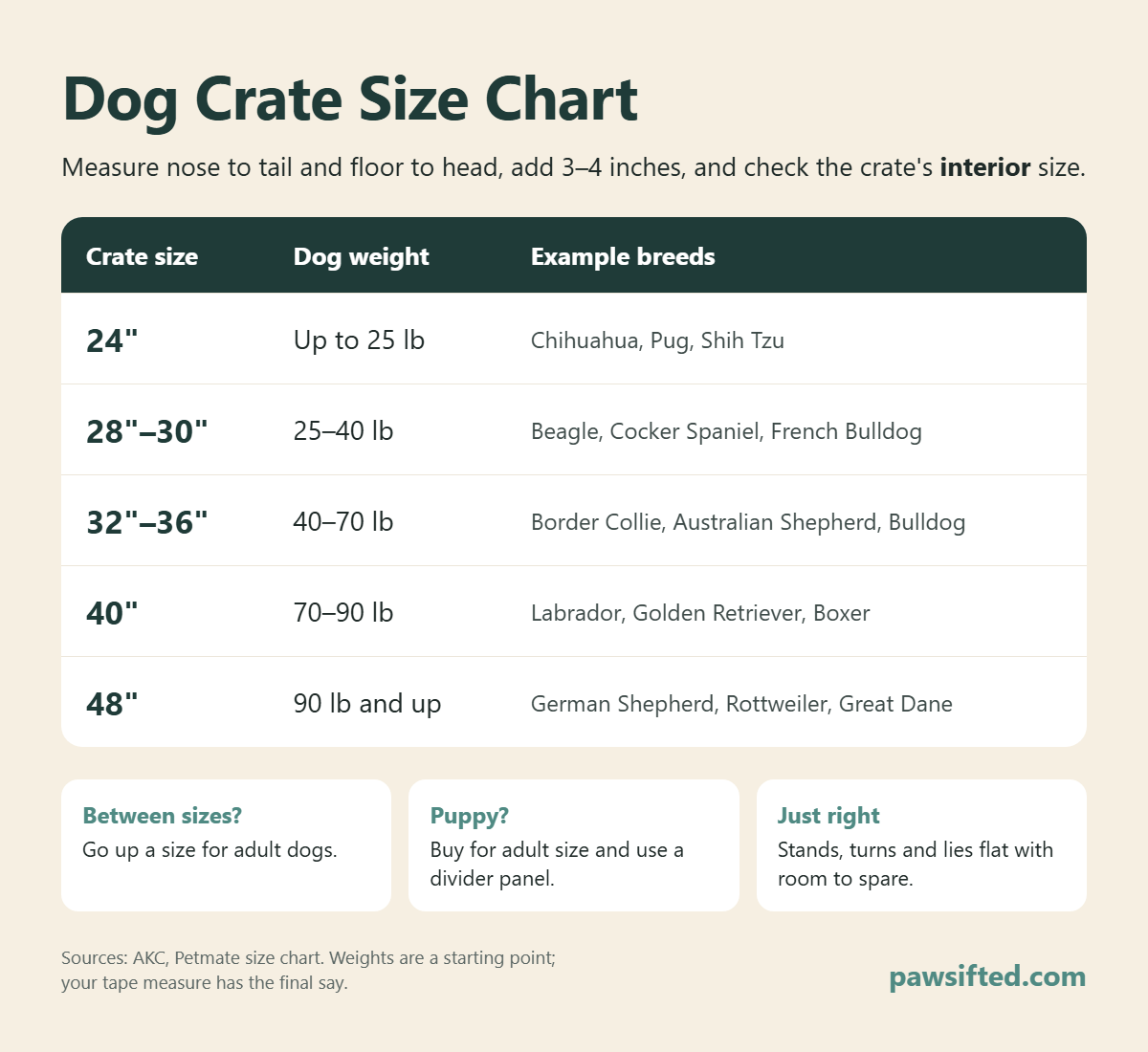
Shelters, rescues, trainers and vet clinics are welcome to print this chart for adoption packets, puppy classes or the front desk. The one-page PDF adds the measuring steps, a fit check and a space to write down your dog’s numbers.
Share it on your site
Copy this code to show the chart on your page, with a credit link back to this guide:
Plastic travel kennel sizes
Plastic kennels are named by outside length too, but their thick walls take up more room than wire, so the inside is noticeably smaller. Here is one manufacturer’s published chart for a plastic kennel that the maker says meets the International Air Transport Association (IATA) Live Animals Regulations:
| Kennel size | Dog weight | Interior (L x W x H, inches) |
|---|---|---|
| 21″ | Up to 15 lb | 18.75 x 13.5 x 14.5 |
| 28″ | 25–30 lb | 24.25 x 18.25 x 19.5 |
| 32″ | 30–50 lb | 29.5 x 19.75 x 23.5 |
| 36″ | 50–70 lb | 32.5 x 22 x 26 |
| 40″ | 70–90 lb | 36.25 x 24.75 x 28.8 |
| 48″ | 90–125 lb | 44 x 29 x 32.5 |
For air travel, IATA’s rule is that the container must let your pet stand and sit upright, turn around normally while standing, and lie down in a natural position. Airlines add their own requirements on top, so check with your airline before you buy. For car trips, a snug crate is safer than a roomy one, because a dog has less space to be thrown around in a sudden stop. Our best dog crates for travel guide covers crash-tested and airline-style options.
Sizing a crate for a puppy
A puppy’s crate should be just big enough to stand up, turn around and lie down comfortably. The AKC explains why: if the crate is too large, a puppy can eliminate at one end and sleep at the other, which slows house training.
Rather than buying a new crate every few months, the AKC and MidWest both suggest buying a crate sized for your puppy’s expected adult size and using a divider panel. Set the divider so your puppy has only enough room to lie down and turn around, then move it back as they grow. MidWest says most of its crates include a divider panel, which should fit across the width of the crate. For a mixed-breed puppy, estimate adult size from the parents if you know them, or ask your vet or rescue.
Too small, too big or just right?
- Too small: your dog has to duck their head to stand, can’t turn around without bumping the sides, or can’t stretch out when lying down. Petmate notes that a dog in a too-small kennel will be uncomfortable and may avoid it.
- Too big: a puppy or a dog that is still house training has room to soil one corner and rest in another. Use a divider until they are reliable.
- Just right: your dog can stand, turn and lie flat on their side with a few inches to spare in each direction.
If your dog pants heavily, drools, howls or tries frantically to escape when crated, the problem may not be size at all. The ASPCA says these can be signs of separation anxiety, and crating may not be the right approach; talk to your vet or a qualified trainer.
How long can a dog stay in a crate?
Humane World for Animals advises that puppies under 6 months shouldn’t stay in a crate for more than three or four hours at a time, and that adult dogs shouldn’t be crated for more than four to five hours during the day. The AKC uses a rule of thumb for bladder control: a puppy can usually hold it for about their age in months plus one hour. Every dog is different, so ask your vet if you are unsure. For safety, the AKC recommends taking your dog’s collar off while they are in the crate so it can’t catch on the wire.
Frequently asked questions
What size crate does a 50-pound dog need?
Petmate’s chart puts 40- to 70-pound dogs in a 32- to 36-inch crate, and its Sky Kennel chart starts the 36-inch size at 50 pounds. A long-bodied or tall dog may need more room than that. Measure your dog and add 3 to 4 inches before choosing.
Should I measure to the base or the tip of the tail?
Crate makers usually measure to the base of the tail, while the AKC measures to the tip. If your result falls between two sizes, measuring to the tip and choosing the larger crate gives your dog more room.
Is it better to buy a crate that is too big or too small?
Slightly too big is better than too small for an adult dog, because a cramped crate is uncomfortable. For a puppy, a big crate is fine as long as you use a divider to shrink the space during house training.
Are crate sizes the same across brands?
No. A “36-inch” crate is named by its outside length, and the inside space and recommended weights vary by brand and by material. Plastic kennels in particular have less interior room than wire crates of the same nominal size.
How we chose
This is a research-based guide; we didn’t measure dogs or crates ourselves. We compared the AKC’s measuring and crate-training advice with published size charts from Petmate and MidWest, IATA’s container rule for air travel, and crate-time guidance from Humane World for Animals. Where sources disagree, such as tail base versus tail tip, we say so and explain which choice gives your dog more room. Read our full editorial policy.
Sources and further reading
- Crates for Dogs: How to Choose the Best Dog Crate (American Kennel Club): Explains how to measure a dog for a crate (nose to tail tip, floor to top of head, plus 3 to 4 inches) and how to size a crate for a growing puppy.
- How to Crate Train Your Dog in 9 Easy Steps (American Kennel Club): Covers why an oversized crate can slow house training, using a divider in an adult-size crate, and removing the collar while a dog is crated.
- Indoor Dog Kennels: A Complete Buyer’s Guide (Petmate): Manufacturer guide with a kennel size chart by dog weight and example breeds, plus measuring tips.
- Sky Kennel (Petmate): Product page listing exterior and interior dimensions and weight ranges for each kennel size, and the maker’s IATA compliance statement.
- Traveler’s Pet Corner (IATA): Sets out the basic container rule for flying pets: the animal must be able to stand, sit, turn around and lie down naturally.
- How to Crate Train Your Dog or Puppy (Humane World for Animals): Crate-training guide with suggested maximum crate times for puppies and adult dogs.