Updated November 2026 · Research-based guide · We may earn a commission from links on this page.
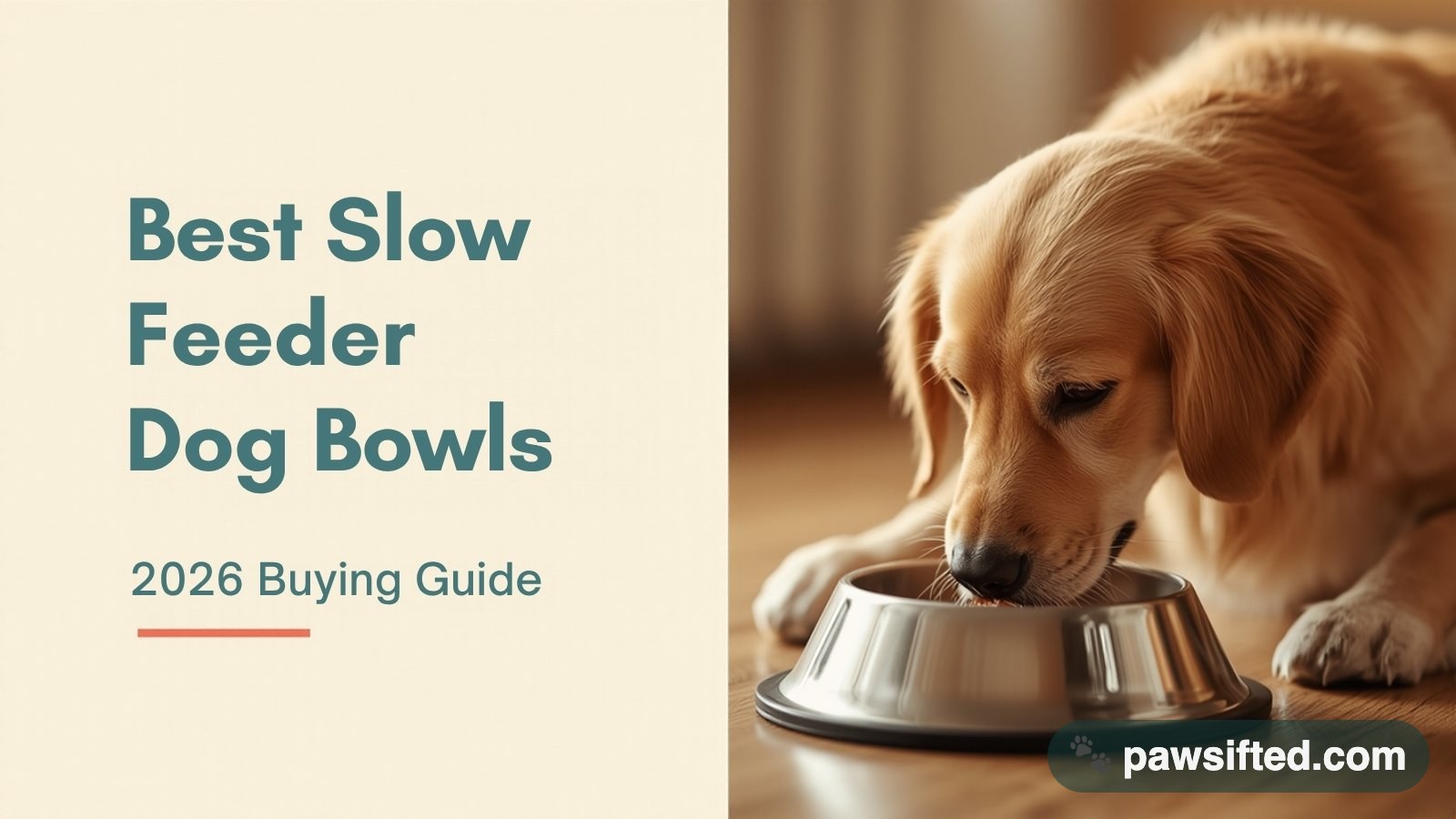
If your dog empties a full bowl in the time it takes you to put the bag away, you are not alone. Gulping can lead to coughing, choking, or bringing the meal right back up, and the American Kennel Club notes that swallowing extra air while eating fast may add to the risk of bloat. The best slow feeder dog bowls break a meal into small bites by forcing your dog to work around ridges, posts or “grass” so dinner lasts minutes instead of seconds.
There is no single best slow feeder, though. A Labrador who inhales kibble needs a different bowl than a Pug who struggles to reach food, a raw-fed terrier, or a dog who eats on road trips. Below we compare six well-reviewed options by material, capacity, difficulty and cleaning, then help you match one to your dog. This guide is general information, not veterinary advice; if your dog vomits often or belongs to a bloat-prone breed, talk with your vet.
Top picks at a glance
Best overall
Outward Hound Fun Feeder Slo Bowl
The proven plastic maze, in sizes for toy to large dogs.
Best stainless steel
Neater Pets Non-Tip Stainless Steel Slow Feeder
Easy-clean metal bowl with a center post.
Best puzzle-style feeder
Northmate Green Interactive Feeder
Grass-style blades turn dinner into a foraging game.
Best overall
1. Outward Hound Fun Feeder Slo Bowl
The Fun Feeder is the bowl most slow feeder roundups start with, and for good reason. Its maze of curved ridges comes in several pattern and difficulty levels, and Chewy lists it in roughly three capacities: about ¾ cup, 2 cups and 4 cups, so it can fit anything from a toy breed to a large dog. It is made from food-safe ABS plastic that the listing describes as free of BPA, PVC, lead and phthalates, and it has a non-slip base so it does not skate across the kitchen floor. Outward Hound says it can slow eating up to 10 times; treat that as a best-case manufacturer figure, but many customer reviews say it makes a clear difference for kibble eaters.
- Good: Many sizes and maze patterns, food-safe plastic, non-slip base, top-rack dishwasher safe.
- Watch out: Clever dogs can learn the maze over time, and determined chewers may gnaw the plastic ridges.
- Skip it if: your dog destroys plastic bowls; a stainless or rubber option will last longer.
Best for large dogs
2. JW Pet Skid Stop Slow Feed Bowl
Big dogs need a bowl that holds a full meal without overflowing, and the JW Pet Skid Stop is one of the few slow feeders sold in a 6-cup size, which Chewy lists at about 13.25 inches across. There is also a small 1-cup version. The plastic body has a heavy thermoplastic rubber rim and base to stop sliding, and it is listed as dishwasher safe and stain resistant. The obstacle pattern is simpler than a deep maze, which makes it a gentle first step for a dog that has never used a slow feeder.
- Good: Large capacity for big kibble meals, rubber rim and base, dishwasher safe, easy for beginners.
- Watch out: Less challenging than maze bowls, so very fast eaters may still finish quickly; colors often ship at random.
Best stainless steel
3. Neater Pets Non-Tip Stainless Steel Slow Feeder
If you prefer metal over plastic, Neater Pets makes a stainless steel bowl with a raised center “bundt” that forces your dog to eat around the edge. It is listed in 2-cup and 3-cup sizes on Chewy, with larger sizes sold elsewhere, and the maker describes it as dishwasher safe, BPA-free and lead-free. A rubber ring on the bottom is meant to keep it from tipping or sliding. The single-post design is a milder challenge than a maze, but stainless steel is easy to sanitize and is hard for a chewer to damage.
- Good: Stainless steel body, dishwasher safe, simple design that is easy to clean, chew resistant.
- Watch out: Several buyers report the rubber ring coming loose; one center post slows some dogs only a little.
- Skip it if: your dog needs a hard puzzle to slow down.
Best puzzle-style feeder
4. Northmate Green Interactive Feeder
The Danish-made Green feeder replaces ridges with plastic “blades of grass” of different heights. Kibble or wet food settles between the blades, and your dog has to nose and lick it out a few pieces at a time, which feels more like foraging than eating from a dish. The standard size measures about 40 x 30 x 10 cm (roughly 15.7 x 11.8 x 3.9 in), some retailers also sell a smaller Mini, and the feeder is listed as dishwasher safe. The maker advises supervising the first few meals and not using it if your dog has sore gums or mouth problems.
- Good: Very effective at slowing eating, works with wet and dry food, doubles as enrichment, dishwasher safe.
- Watch out: Takes longer to clean by hand, and some dogs get frustrated at first, so introduce it gradually.
- Skip it if: your dog has dental pain or mouth injuries.
Best for wet or raw food
5. LickiMat Wobble
Slow feeders built for kibble often trap wet food in corners. The LickiMat Wobble is a weighted, rubbery bowl (about 6.5 x 6.5 x 3.1 in) made from food-safe TPR, with two textured surfaces you can flip, and it wobbles as your dog licks. The maker lists it for raw, wet, dry or liquid meals and spreads, and says it is dishwasher safe, freezer safe and microwave friendly. Freezing a meal in it can stretch eating time even further. It is compact, so it suits small dogs or smaller portions better than a large dog’s full dinner.
- Good: Great for wet, raw or soaked food, can be frozen, flexible material, two textures.
- Watch out: Small capacity; the maker says it is strong but not indestructible, so check it for chew damage.
- Skip it if: you feed large portions of dry kibble.
Best height-adjustable
6. Neater Pets Adjustable Slow Feeder
This plastic slow feeder comes with a base and leg extensions so you can set it at about 2, 3 or 4.5 inches tall. It holds about 2.5 cups, is described as BPA-free and dishwasher safe, and has a non-skid bottom. Neater Pets says the wells are spaced for all nose shapes, which makes it worth a look for small dogs, cats and some flat-faced breeds, though one customer review noted wet food can sit out of reach at the bottom of the wells. A raised option can be more comfortable for some seniors, but ask your vet before raising the bowl for a large, deep-chested dog: a 2000 study in the Journal of the American Veterinary Medical Association linked raised bowls with a higher risk of bloat (GDV) in large and giant breeds (see the FAQ).
- Good: Three height settings, non-skid bottom, dishwasher safe, also works for cats.
- Watch out: Needs assembly, moderate capacity, and wet food may be hard to reach in the deepest wells.
- Skip it if: you have a large, deep-chested dog and your vet prefers floor-level feeding.
Compare the picks side by side
| Pick | Best for | Why it stands out | Main trade-off |
|---|---|---|---|
| Outward Hound Fun Feeder Slo Bowl | Best overall | The proven plastic maze, in sizes for toy to large dogs. | Clever dogs can learn the maze over time, and determined chewers may gnaw the plastic ridges. |
| JW Pet Skid Stop Slow Feed Bowl | Best for large dogs | A 6-cup option that fits a large dog’s full meal. | Less challenging than maze bowls, so very fast eaters may still finish quickly; colors often ship at random. |
| Neater Pets Non-Tip Stainless Steel Slow Feeder | Best stainless steel | Easy-clean metal bowl with a center post. | Several buyers report the rubber ring coming loose; one center post slows some dogs only a little. |
| Northmate Green Interactive Feeder | Best puzzle-style feeder | Grass-style blades turn dinner into a foraging game. | Takes longer to clean by hand, and some dogs get frustrated at first, so introduce it gradually. |
| LickiMat Wobble | Best for wet or raw food | Rubbery, freezable bowl for wet and raw meals. | Small capacity; the maker says it is strong but not indestructible, so check it for chew damage. |
| Neater Pets Adjustable Slow Feeder | Best height-adjustable | Raise it to 2, 3 or 4.5 inches for comfort. | Needs assembly, moderate capacity, and wet food may be hard to reach in the deepest wells. |
Which slow feeder dog bowl fits your routine?
Large dog that inhales kibble
Start with the JW Pet Skid Stop 6-cup or the 4-cup Outward Hound Fun Feeder. Both hold a full large-breed meal, and you can split dinner into two smaller servings if it overflows.
Small or toy breed
The ¾-cup or 2-cup Fun Feeder, or the LickiMat Wobble for small wet-food portions, keep the obstacles scaled to a small muzzle.
Flat-faced dog (Pug, Frenchie, Bulldog)
Look for shallow, widely spaced ridges, such as the Neater Pets Adjustable feeder or an easier Fun Feeder pattern. Deep, narrow mazes can frustrate a short snout.
Wet, raw or fresh food
The LickiMat Wobble or the Northmate Green handle soft food better than tight plastic mazes, and the Wobble can be frozen for a longer meal.
Power chewer
Choose the Neater Pets stainless steel bowl and pick it up after meals. Plastic and silicone bowls are not chew toys.
Travel and camping
Pack your dog’s usual slow feeder if it travels well, so meals stay slow at campgrounds and hotels. Collapsible silicone bowls pack flat, but most do little to slow eating.
How to choose a slow feeder dog bowl
Match capacity to the real meal
Measure your dog’s full serving, then choose a bowl that holds it with room to spare. Ridges take up space, so a “3-cup” bowl may hold less once kibble fills the gaps. If you feed large meals, consider splitting them in two.
Pick a difficulty your dog can win
The goal is slower eating, not frustration. Start with an easier pattern and move to a tougher maze once your dog gets the idea. Signs a bowl is too hard include pawing, flipping the bowl or walking away hungry.
Consider snout shape and kibble size
Short-nosed dogs need wider, shallower channels. Very large kibble can jam in tight mazes, while tiny kibble can make simple ridges too easy.
Choose the right material
Plastic is light and offers the most maze designs. Stainless steel is the easiest to sanitize and resists chewing. Rubber and silicone are flexible, quiet and good for licking but can be chewed. Check that any plastic is described as BPA-free and food-safe.
Check stability and cleaning
A rubber base or rim keeps the bowl from sliding. Deep mazes trap food, so look for dishwasher-safe bowls and wash them after every meal, especially if you feed wet or raw food.
Think about height carefully
Most slow feeders sit on the floor. Raised feeders can help some seniors, but research has linked elevated bowls to higher bloat risk in large and giant breeds, so get your vet’s opinion first.
Frequently asked questions
Do slow feeder bowls prevent bloat?
Not on their own. Slowing down may reduce how much air a dog swallows, and the AKC lists slow feeders as one way to reduce risk, but no large study has proven that slow feeders prevent bloat (GDV). Feeding smaller, more frequent meals and avoiding hard exercise around meals also help. GDV is an emergency: if your dog has a swollen belly, retches without bringing anything up or seems restless and in pain, go to a vet right away.
What is the best slow feeder for a large dog?
Pick one that holds a full meal. The JW Pet Skid Stop comes in a 6-cup size and the Outward Hound Fun Feeder in a 4-cup size, which suits most large-breed portions. If dinner still overflows, split it into two smaller servings. For large, deep-chested breeds, keep the bowl at floor level unless your vet says otherwise, because the 2000 JAVMA study linked raised bowls with a higher risk of bloat.
What slow feeder is best for a small dog?
Choose a small bowl with an easy pattern so the obstacles fit a little muzzle. The Outward Hound Fun Feeder comes in ¾-cup and 2-cup sizes, and the LickiMat Wobble works well for small wet-food portions. Flat-faced small breeds such as Pugs and Frenchies usually do better with shallow, widely spaced ridges than with deep, narrow mazes.
Are slow feeders good for puppies?
Yes, many puppies do well with an easy pattern. Choose a size that fits their small muzzle and switch to a bigger bowl as they grow. Supervise early meals so they do not chew the bowl.
Can I use a slow feeder for wet food?
You can, but rubbery, lick-style or grass-style feeders are easier to clean than tight plastic mazes. Wash them after every meal so food does not sit in the grooves.
How do I get my dog used to a slow feeder?
Put a few high-value treats in the easiest part of the bowl first, then add part of a normal meal. Praise calm eating and only move to a harder pattern once your dog finishes without frustration.
Can I make a DIY slow feeder?
For a quick fix, the AKC suggests spreading kibble on a baking sheet or muffin tin, or placing an upside-down smaller dish in a larger bowl. Make sure anything you use is clean, stable and too large to swallow.
How we chose
We did not test these bowls hands-on. We compared current expert roundups (Dogster, Hepper, iHeartDogs), manufacturer and retailer specifications, owner feedback patterns, and AKC guidance on fast eating and bloat, and we checked for recall notices on the product type. We favored bowls with clear capacity information, food-safe materials, non-slip bases and easy cleaning, and we left out anything whose basic specs we could not confirm. Prices change often, so we do not list them. Read our full editorial policy.
Sources and further reading
- How to Help Your Dog Eat More Slowly (American Kennel Club): Explains how gulping air while eating fast is linked to bloat and describes slow-feed bowls plus DIY options such as a baking sheet or muffin tin.
- Bloat (or GDV) in Dogs: What Is it and How Is it Treated? (American Kennel Club): Veterinarian-written overview of GDV warning signs and risk factors, including eating speed, once-daily meals, and bowl height, and notes that evidence on slow feeders is inconclusive.
- Non-dietary risk factors for gastric dilatation-volvulus in large and giant breed dogs (PubMed; Journal of the American Veterinary Medical Association): Abstract of Glickman et al. (JAVMA, 2000), a prospective study of 1,637 large and giant breed dogs that linked faster eating and raised feed bowls with higher GDV risk.